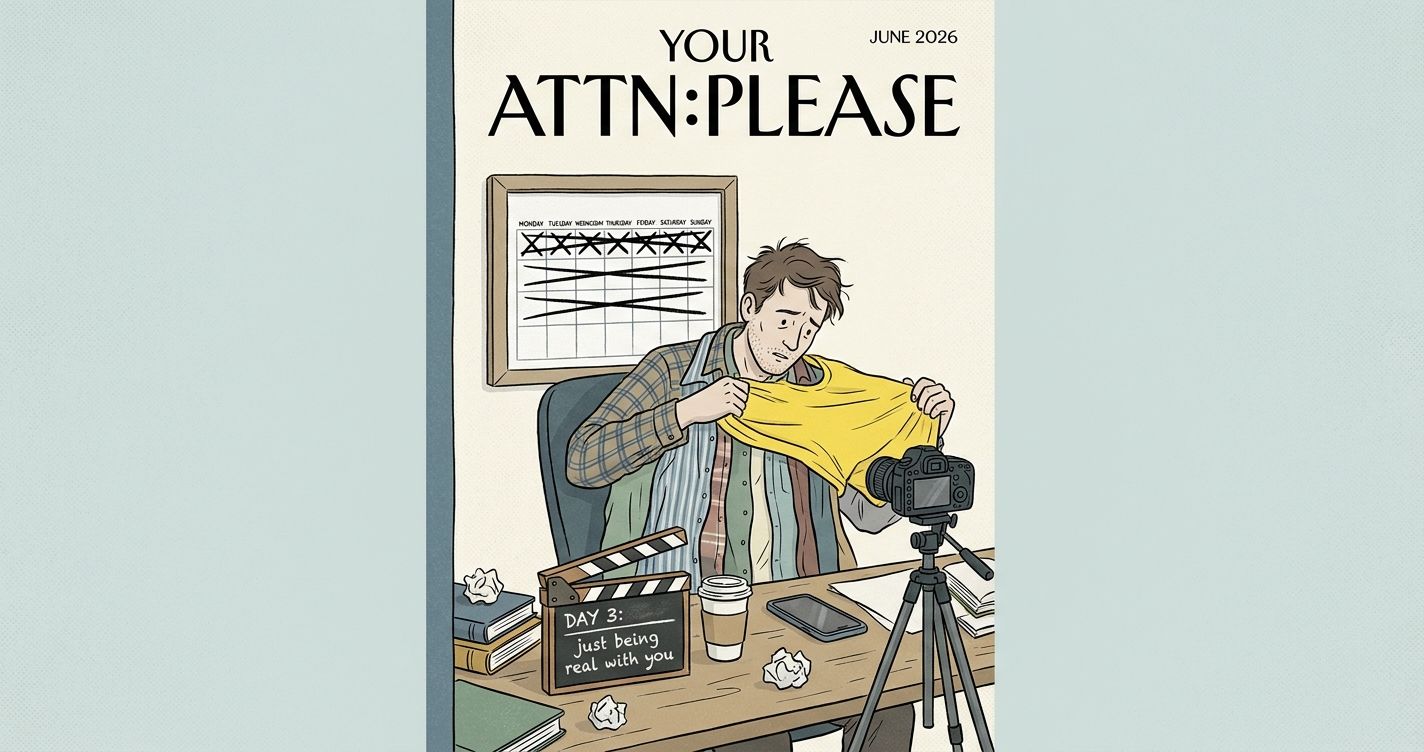
Batching means creating a week or more of content in one session. It works brilliantly for brand content built on repeatable formats, where you can film 10 to 20 pieces in a day. It fails for personal journey content, which only works captured in the moment. Know which type you are making before you book the filming day.
Every productivity guru tells you to batch your content. Here is the uncomfortable truth: for a lot of what actually grows an audience in 2026, batching is the wrong tool. I run both kinds of content every week, batched and live, and the split matters more than the batching. This guide covers when batching fails, what to build instead, when it wins, and how to run a proper batch day.
When batching fails: journey content
Personal brand content is your journey told as it happens: the deal that landed today, the thing that broke this morning, the win your team had an hour ago. You cannot batch Tuesday’s reality on Sunday night. Batched journey content reads exactly like what it is: pre-packaged life.
The pull of batching is control. But audiences follow journey content because it is live. The texture of “this happened today” is the product. Fake that and you have lost the only thing the format had.
Build a capture structure instead
The answer for journey content is not batching, it is a capture system: a structure that catches the moments of your real day and turns them into posts fast. Lower the cost of creating in the moment until it takes minutes, and you get daily authentic content without the daily blank page.
Here is what mine looks like right now. An AI system reads my meetings, my calendar, and my email every night, and every morning it drops draft posts built from what actually happened yesterday into a chat. I pick one, edit it in my own words, and post. The moment stays real. The writing time drops to minutes. That is a structure doing the job people try to force batching to do.
- Capture: a system (or a habit) that logs the real moments daily.
- Draft: turn moments into rough posts fast, same day or overnight.
- Edit: you, in your own voice, in minutes.
- Post: daily, while it is still warm.
When batching wins: repeatable formats
Batching is the right tool when the content is a format, not a moment. An Easy Repeatable Content series, one structure with one changing variable, can be filmed 10 or 20 episodes at a time. Podcasts work the same way: record once, clip it into weeks of short-form.
This is how we produce brand content across our client accounts. The format carries the quality, so filming twenty in a day does not flatten it: episode 14 is as good as episode 1 because the structure does the work. Film a day, release over weeks. The format was never pretending to be live, so nothing is lost.
How to run the batch day
A good batch day is one location, one setup, and a stack of pre-written scripts or one repeatable format. Change shirts between takes if you want variety. Hand the footage to an editor and release on a schedule. One day of filming should feed two to four weeks of output.
- Lock scripts or episode variables before the day. The day is for filming, not deciding.
- One location, one lighting setup. Resetting kills batch days.
- Film in format order, not calendar order. Stay in one mode at a time.
- Clip and schedule the same week, while decisions are fresh.
FAQ
Should I batch create my social media content?
Batch your format-based brand content. Never batch your personal journey content. Most creators need both: a batch day for the formats, and a capture structure for the live stuff.
How much content can you film in one day?
With a repeatable format and locked scripts, 10 to 20 short-form pieces is realistic. Without a format, you will get far fewer, and they will feel flat.
What tools do you need to batch content?
Less than you think: a camera or phone, one decent light, a teleprompter app if you script, and an editor (human or AI) on the back end. The real tool is the format.
How do I make batched content feel fresh?
You do not. You stop using batching for content that needs to feel live, and use it only where the format carries the energy. That is the whole trick.
Keep reading: production workflows hub · content repurposing: post it again · linkedin marketing guide