
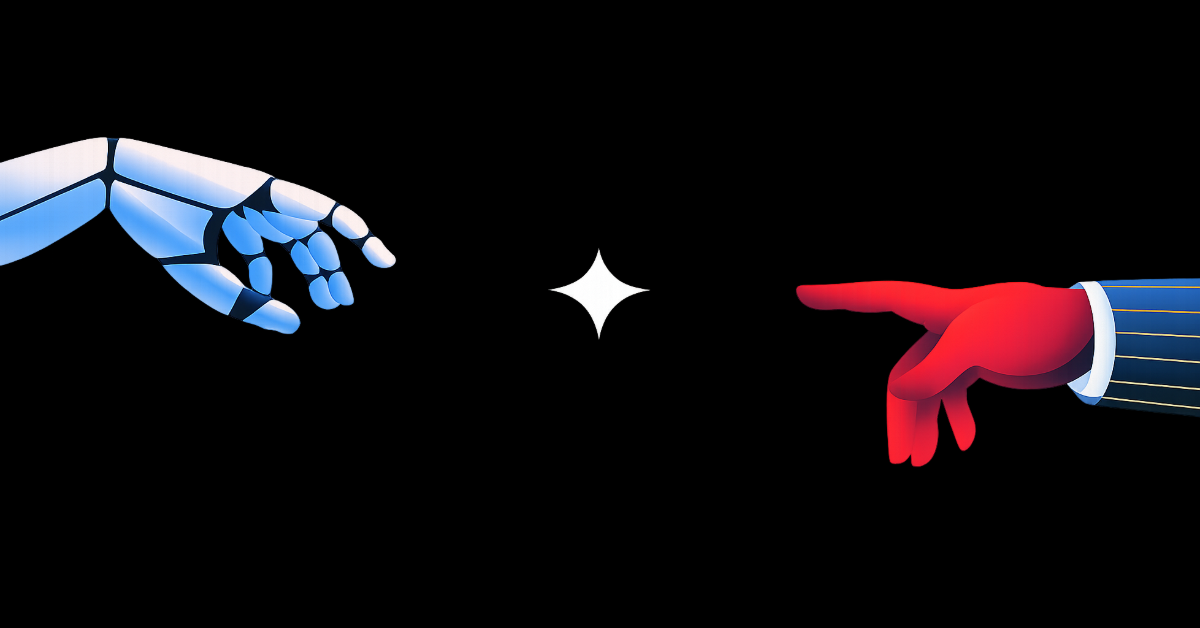
I need to tell you a secret: I get scared too.
No matter how many times I stand on my digital soapbox and preach about why human voices cannot be replaced, there are honestly days when the noise gets too fkn loud.
There are days when I look at the breakneck speed of Large Language Models or read another LinkedIn post celebrating how a marketing department "scaled content by 500% with zero headcount," and I feel a cold spike of panic in my chest.
If you make your living by pulling thoughts out of your head and turning them into words on a page, you are currently living through a grinding psychological war.
You're constantly being told that your craft is a commodity.
You are being asked by clients if your hard-won prose was generated by a machine. You are defending your own right to exist to people who view language as nothing more than inventory.
I see you. I hear you. I am right there in the trenches with you.
And today, I want to look the monster directly in the eye. Let’s look at the terrifying facts, look at where the puck is actually heading, and talk about why the future doesn’t belong to the machines—it belongs to the writers who refuse to be smoothed out. Together x
The ugly truth: the numbers don't lie
We cannot fix a problem if we pretend it isn't happening. The market shift is structural and systemic.
- The entry-level wipeout: Industry analyses across freelancing platforms like Upwork and Fiverr show that entry-level SEO writing, basic copywriting, and programmatic blog post jobs have dropped by over 30% since the boom began. The "middle class" of low-stakes content writing is being aggressively automated.
- The mid-century parallel: If you think about it, we are seeing a repetition of history. Just like the mid-century factory boom transformed handmade furniture into mass-produced, flat-packed Swedish plastic, corporate marketing is currently obsessed with flat-packed text. It’s cheap, it’s fast, and it fills the shelf.
- The prediction for 2027: Enterprise tech projections suggest that by next year, 80% of routine corporate comms, basic product descriptions, and standard ad copy will be AI-first, human-edited second.
If your job description was simply "putting words on a page," the market is leaving you behind. The machine can do that in four seconds for fractions of a penny.
But the plot twist that the tech evangelists are completely missing (and one I’ve spoken about many a time) when everything becomes frictionless, friction becomes the luxury asset.
The tragedy of the seamless feedback loop
AI is a statistical mirror. It looks at everything we have ever written, calculates the average response, and spits it back out. It is designed to be smooth, predictable, and entirely devoid of risk.
The result is that the internet is currently suffering from acute semantic fkn bleaching.
Every corporate announcement sounds identical. Every ebrand manifesto reads like it was written by the same mildly enthusiastic committee. The feed has become a gray, seamless soup of "in today's fast-paced digital landscape."
And human beings are violently allergic to boredom.
The human brain is an anomaly detector. We look at things that are jagged, not smooth. The sentence that takes a weird left turn. The deeply specific, slightly embarrassing personal anecdote. The raw, unfiltered opinion that might actually get someone fired (oh hey, it’s me).
AI cannot create originality because originality requires the risk of being wrong. It requires a body, a childhood, a heartbreak, a weird interaction at a coffee shop this morning, and the specific, unrepeatable neuroses that make you you.
The machine can mimic the structure of a love letter, but it can never emanate the heat of the human hand that wrote it.
The writer’s playbook:
If we want to survive, we have to stop trying to compete with the machine on its terms. You cannot write faster than Claude, and you cannot write cheaper than ChatGPT.
So, stop trying.
Instead, you need to elevate your craft to the parts of the spectrum the code cannot reach:
1. Cultivate defiant taste
In 2026, your value is no longer your output speed; it is your curation and taste. Anyone can generate 10,000 words on a topic. But the person who has the taste to say: "These 9,900 words are garbage, but these 100 words have a soul.” That’s the writer who survives the Apocalypse.
2. Weaponise the "I"
AI can never write from first-person authority. It has never built a business, it has never sat in a pitch meeting, and it has never felt the dread of a tanking conversion rate. Double down on lived experience. Write pieces that start with: "I spent three weeks looking at this data, and here is the human mess I found."
3. Introduce human friction
Stop trying to write perfectly. The machine is perfect. Write with rhythm. Write with weird fragments and short sentences that hit like a slap to the face. Break grammatical rules intentionally to create an emotional cadence that a predictive text algorithm would never choose.
To my fellow writers: do not lay down your pens.
The world doesn't need more text. We are drowning in text.
What the world needs is truth. It needs perspective. It needs the electrical current that passes between two human minds when one person says something so startlingly honest that the other person feels less alone. It needs PASSION. And mess. And heat.
The machine can give them the data. But only you can give them the blood, the sweat, and the magic.
Keep writing. The feed is dark, but your voice is the light.
Stay safe, my soldiers x
-Sophie Randell, Writer