
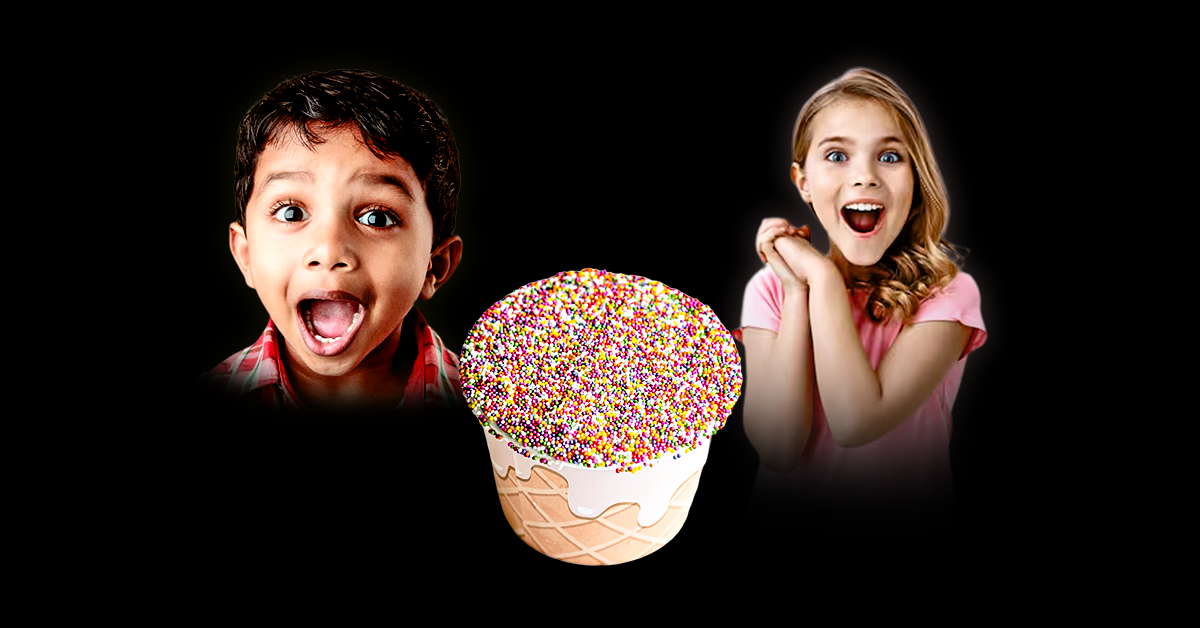
I’m sure you’re well aware that the internet has been absolutely taken over by Hundreds & Thousands.
The distinct, sharp, almost violent sound of a heavy metal spoon cracking through a cement-thick layer of rainbow nonpareil sprinkles is usually the first thing to assault my ears when I open my phone. And has been for the last few weeks.
If you haven’t seen it yet, congratulations on spending time outside. But for the rest of us, we are trapped in the absolute cultural chokehold of the Dot Cake.
Pioneered by New York’s The Dotcakes bakery and causing blocks-long lines at Manhattan's Butterfield Market, the product is deceptively simple: an 8-ounce plastic cup packed with box-style cake, standard frosting, and a hyper-dense crust of crunchy dots. It costs eleven dollars. People are waiting two hours in the rain for it.
Naturally, the internet cynics are throwing hands.
"It’s literally just grocery store sheet cake deconstructed into a plastic cup. Go make it yourself!"
I think maybe they’ve missed the point.
The Dot Cake craze isn’t about the baking. It is a whole thing when it comes to modern consumer psychology, sensory marketing, and the exact mechanics of what happens when a product is engineered to be a content generator.
But it’s also a symptom of a profound cultural regression. We have completely eliminated hunger from our vocabulary and replaced it with a permanent reservation at the kid's table.
When food is sweeter, hyper-coloured, and available at any moment, the concept of a "treat" dies.
We are currently sitting at the absolute peak of a historical bell curve of consumption.
Before refrigerators and pre-packaged convenience, food was fragile. A cake, a loaf of bread, or a piece of fruit was highly perishable. It had to be baked and enjoyed quickly in one place. Ingredients were irregular; preservation was a luxury. Sweets were rare because they physically could not exist in perpetuity.
More importantly, kids and adults shared the exact same diet. There was no "kid food." Food was food. Everyone showed up to the table hungry, without debating likes or dislikes, and without picking or choosing. You ate to live.
In her book Picky, historian Helen Zoe Veit tracks the precise moment this shifted during the mid-century rise of manufactured kid food trends:
“Small cakes and pies have become a staple, not a treat. Researchers noted, with middle-class housewives describing [cakes] as a necessity on their grocery list, and children thinking of them as routine.”
Fast forward to 2026, and we are living in the hyper-evolved, dystopian endgame of that shift. We are all picky now. Every food must be a comfort. We survive on an endless rotation of grazing boards, "little treats," and snack tins. All designed to save us from the terrifying prospect of an empty stomach.
The modern tongue has a job, and we refuse to let it go unemployed. And if the, you know, consequences get too bad, well then, throw every GLP-1 weight-loss drug at us, just so we can dull the appetite enough to keep grazing in teeny-tiny, minimal-effort ways.
The Dot Cake is the ultimate manifestation of this. It requires zero proactive transformation. It asks nothing of our palate. It is an $11 cup of pure regression.
Food trends don’t go viral because they taste like a Michelin-starred meal. They go viral because they feed our emotional deficits.
We like to think of ourselves as rational consumers, but a two-hour line for a cup of cake proves otherwise. There are deep psychological drivers happening underneath that sprinkle crust:
- Whimsy-maxxing as escapism: In a world full of heavy headlines, consumers are lean-maximalising joy. An aggressive, childlike volume of rainbow sprinkles is a low-cost, high-dopamine shot of “I don’t live in a world run by paedophiles” even if it only lasts 5 minutes.
- The nostalgia bait: Underneath the premium packaging, a Dot Cake tastes exactly like a 2002 Betty Crocker Funfetti childhood birthday party. And this totally taps into our yearning for a much simpler era, just wrapped in an modern bow.
- TikTok tourism: Waiting in line for a viral treat is a whole event itself. When people buy a Dot Cake, they are purchasing a physical passport to their digital feed. They’re buying proof of presence.
So, how does a brand successfully monetise this collective desire to sit at the kid's table?
They build the marketing directly into the sensory design of the product, exploiting three distinct digital mechanics:
1. The sensory hook (ASMR)
The algorithm rewards sensory extremes. Dot Cake content relies entirely on a purely acoustic, tactile hook: running a spoon across that cobblestone sprinkle crust to capture a highly satisfying crack before plunging into fluffy cake.
2. The outrage engagement flywheel
The fastest way to get pushed to the mass market is to trigger a debate. Because the cake is so basic, it triggers immediate backlash from people yelling "you're being scammed!". That tension drives thousands of comments. Those comments create traction.
3. The copycat loop
Because a Dot Cake is structurally simple, home bakers can instantly dupe it. This creates an exponential web of free user-generated content that cements the original creator as the cultural blueprint.
Viral marketing used to mean writing a clever tweet or hiring a massive influencer.
But today, the absolute winners are the brands that understand the deep psychological undercurrents of our cultural exhaustion.
We don't want complex. We don't want adult. We want a spoon, a plastic cup, and a loud, crunchy distraction from the void.
-Sophie Randell, Writer