The foundational mandate of being an influencer has always been simple: Show people what you have so they will want it too.
A lot of early use of social media was making yourself look more popular. "Other Halves" and hearts on Bebo, likes on Facebook posts, friend counts on MySpace.
The undisputed law of the Insta timeline was that your digital grid had to scream abundance. If you weren't posting a gallery of champagne flutes at a packed birthday dinner, a blurry transition of a packed festival crowd, or a hyper-filtered look at a sprawling, photogenic family unit, you were like, not that cool.
The algorithm only traded in the additive: look at the people I have, look at the love I attract, look at the life I’ve built.
But lately, the physics of digital envy have done a complete 180. My feed has been hijacked by a subculture that trades exclusively in subtraction. The ultimate status symbol on TikTok right now isn't a tight inner circle or a thriving social calendar.
It’s an aggressively empty apartment and an absolute lack of friends.
I am suddenly trapped in a niche defined entirely by what its creators completely lack: a social life.
We’re in the era of the Loneliness Influencer.
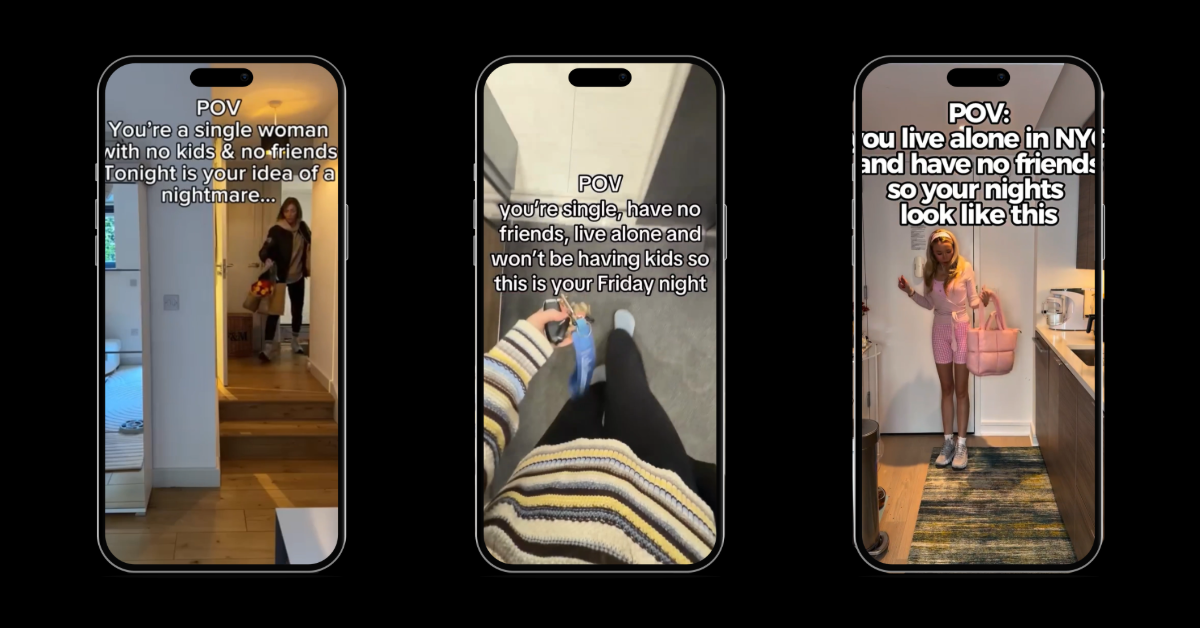
If you haven’t stumbled across these POVs yet, the template is almost eerie in its consistency.
The text on the screen reads something like: “POV: You live alone in London, you have zero friends, and your Friday nights look like this.” Or, “Single, no friends, no kids & grocery shopping by yourself on a Saturday night.”
A typical video shows a young woman, usually a self-described city-dwelling introvert, walking into a spotless, minimalist flat after work. The camera is perfectly positioned on a tripod to capture her shedding her coat. She lights a candle. She plates a solitary, aesthetic dinner. She pours a sugar-free fizzy drink into a crystal wine glass to make it feel special of course.
Then she sits on her sofa, stares at the telly, and the video loops.
Depending on your mental state when you scroll past, the vibe is either deeply tranquil and cosy, or profoundly bleak.
But what makes it fascinating is the execution. These creators aren't crying into their pillows. They are filming their isolation with the exact same high-production, soft-lighting, lifestyle-coded lens that people use to sell luxury wellness retreats.
They have turned the crushing weight of modern urban alienation into an aspirational aesthetic. And that’s kind of crazy to think about.
Why are we so obsessed with watching people have nobody?
Because it feeds into a deeper, systemic shift in how we relate to the world.
- The exclusivity of opting out: In a hyper-connected, deeply exhausting world, social interaction has started to feel like labour. An empty calendar is no longer a sign of social failure; to a burned-out generation, it looks like the ultimate luxury. It’s actually the ultimate boundary.
- The de-stigmatisation loop: There is comfort in seeing your own quiet, unglamorous reality reflected back at you with a high-production value. It tells the viewer: Your lonely existence is a vibe, not a tragedy.
- The ultimate parasocial trait: Here is the dark marketing mechanic underneath the surface: a loneliness influencer is the ultimate parasocial companion. A traditional lifestyle influencer makes you feel inadequate. A loneliness influencer makes you feel understood. They are lonely, you are lonely, therefore, you are lonely together.
But we have to look at the inherent hypocrisy of the format. To create a video about having no friends, you must set up a tripod, record multiple angles of yourself being alone, edit the footage, apply a flattering filter, and upload it to a public square hoping that millions of strangers will validate your isolation.
It is a performance of solitude. It is an audience-driven rejection of humanity.
What this teaches us about the attention economy
If you work in marketing, branding, or content creation, the rise of the loneliness influencer isn't just a weird sociological quirk. It is a loud, clear signal about how consumer desires are shifting.
If you want your brand to connect with an increasingly isolated audience, you have to change how you define aspiration:
1. Move from "aspiration" to "validation"
For decades, marketing was built on making consumers feel slightly bad about themselves so they would buy a product to fix it. The loneliness trend proves the inverse is now true. The brands that win today are the ones that validate the consumer’s current reality. Stop selling the party; start selling the quiet evening after the party.
2. Lean into low-stakes intimacy
Consumers are drowning in hyper-polished, corporate content. Instead of grand narratives, create small, tactile, low-stakes moments of human intimacy. If you are launching a product, don't just show it in use at a massive social gathering. Show the quiet, mundane, single-person ritual of interacting with it.
3. Recognise the "cosy economy"
We are witnessing a massive commercialisation of (everything) comfort. When the outside world feels volatile, expensive, and socially taxing, the home becomes a sanctuary. Products that facilitate small, solitary dopamine hits like premium glassware for solo drinks, high-end loungewear (my personal fave), hyper-specific lighting, are the new status symbols.
We used to use social media to connect with the world.
Now, we use it as a buffer against it. We sit in our separate, hyper-curated, spotless apartments, watching videos of other people sitting in their separate, hyper-curated, spotless apartments.
The loneliness influencer has figured out how to monetise the void. They’ve proven that you don’t need a massive circle of friends to build an empire. You just need a tripod, a glass of soda, and a crowd of people who are exactly as alone as you are.
Which makes me a little sad, if I’m honest ☹
-Sophie Randell, Writer